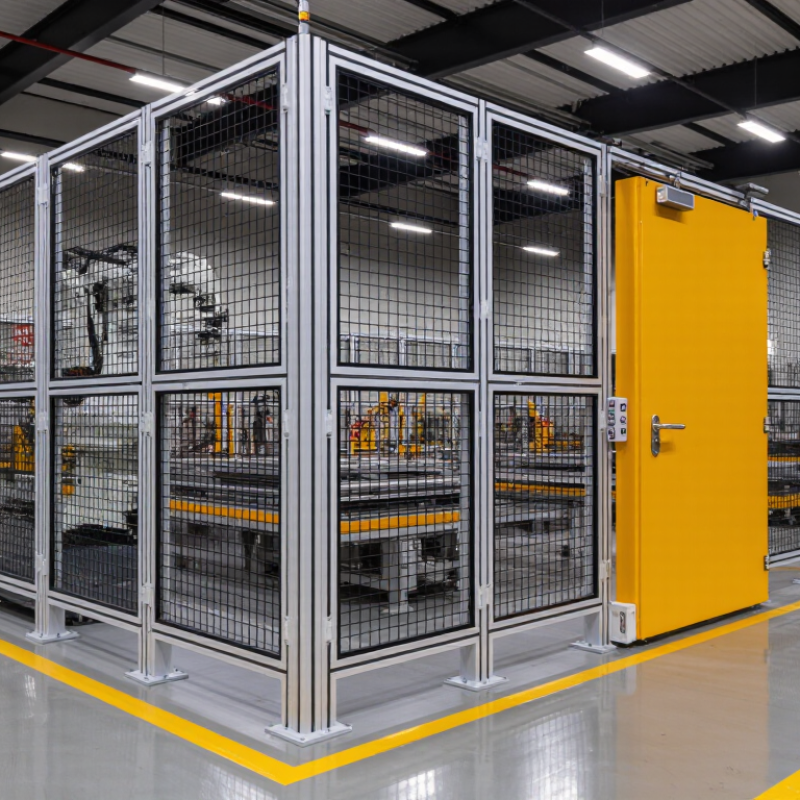
| Small robotic pick-and-place cell | Welded mesh or framed panel system
Typical height: 1,400–2,000 mm | Single hinged personnel door
Clear opening commonly around 700–1,000 mm | Guard-door interlock switch with positive monitoring
Guard locking may be unnecessary when stopping time is shorter than access time | Door-position switch Reset pushbutton Optional presence sensor | Emergency-stop button outside the cell and an additional reachable control inside where personnel may become trapped | Confirm robot stopping time, minimum separation distance, visibility of the work area, and safe restart conditions |
| High-speed robot with hazardous residual motion | Rigid mesh or solid-panel guarding
Typical height: 1,800–2,200 mm | Hinged or sliding door designed for frequent operator access | Guard-locking interlock that keeps the door locked until hazardous motion has stopped
Use monitored dual-channel safety circuits where required by the risk assessment | Coded interlock Safe speed or standstill monitoring Safety relay or safety PLC | Emergency-stop devices at operator stations, loading points, and other accessible locations | The locking release time should be based on measured or validated stopping performance, not on a general preset value |
| Palletizing or depalletizing system | Heavy-duty framed mesh panels with protected transfer openings
Typical height: 1,800–2,500 mm | Sliding maintenance gate plus material-transfer openings designed to prevent reach-through access | Interlocked access gates with controlled restart after every gate opening
Transfer openings should not permit access to hazardous zones | Safety light curtains Area scanners Gate switches | Emergency-stop buttons at pallet infeed, pallet outfeed, operator controls, and maintenance access points | Check pallet dimensions, robot reach, conveyor openings, forklift traffic, and the reset location relative to the guarded area |
| Collaborative robot with occasional manual loading | Partial guarding, fixed barriers, or perimeter protection where the risk assessment identifies residual hazards | Manual access door or removable access panel with controlled entry | Interlock selection depends on the task, robot mode, tool hazard, and whether hazardous motion remains during collaborative operation | Presence sensing Mode selector Speed and separation monitoring | Clearly visible emergency-stop devices located at the operator position and near foreseeable points of access | Collaborative operation does not eliminate the need to assess sharp tools, pinch points, payloads, fixtures, and unexpected restart |
| Welding, cutting, grinding, or spraying cell | Rigid panels with suitable protection against sparks, radiation, dust, or process ejection
Solid panels may be needed for localized hazards | Hinged maintenance door with limited routine access
Use dedicated loading doors when possible | Guard locking or trapped-key arrangement may be appropriate for stored energy, fumes, heat, or delayed hazards | Door interlocks Process enclosure switches Ventilation monitoring | Emergency stops should interrupt the hazardous process and place connected equipment in a defined safe state | Evaluate heat, arc flash, laser or optical radiation, fumes, noise, combustible dust, and stored pneumatic or hydraulic energy |
| Large multi-robot production line | Modular perimeter fencing with multiple controlled access points
Typical height: 1,800–2,500 mm | Multiple hinged or sliding gates, each individually identified and monitored | Safety PLC architecture with monitored interlocks, controlled reset, and zone-based access where justified | Interlock switches Safety scanners Light curtains Zone sensors | Emergency stops distributed by zone, with clear labeling and visibility from normal operating positions | Define safe zones, prevent bypassing, document reset logic, and verify that stopping one zone cannot create a new hazard in another |
| Maintenance and tool-change access | Fixed panels with a dedicated service gate and sufficient working clearance | Lockable hinged door or controlled maintenance access gate | Guard locking, personal lockout provisions, or trapped-key systems may be required where energy isolation is necessary | Access switch Isolation status Safe-state feedback | Emergency-stop controls should remain accessible during maintenance, but they should not replace energy isolation procedures | Provide sufficient space for inspection, cleaning, lubrication, calibration, and removal of tooling without defeating the guard |
| Forklift or pallet-truck interface | Impact-resistant posts, reinforced mesh, and protected corners near traffic routes | Vehicle access gate with controlled opening and pedestrian access gate separated where practical | Interlock the vehicle gate with robot motion and conveyor controls
Consider traffic lights, warning signals, and access authorization | Gate switches Vehicle detection Warning beacons | Emergency-stop devices should be reachable from both pedestrian and vehicle operating positions | Consider impact loads, floor anchoring, turning radius, visibility, pedestrian segregation, and safe access during material handling |